

.svg)
The Hidden Cost of Treating Training as an Afterthought in Oracle Cloud Projects
I have been attending Oracle conferences since the mid-1990s. Across three decades of conversations with system integrators, project sponsors, IT directors and finance leads, I have noticed something that has never really changed: the technology always takes centre stage.
Yet in practice, time-to-value often takes longer than expected.
Every session, every panel, every vendor presentation focuses on integrations, configurations, data migration, testing cycles and go-live readiness. The question is whether the people who will actually use the system on Monday morning are genuinely prepared. That one tends to get left to the final slide — or dropped altogether when the timeline slips.
I founded Fudgelearn in 2017 because of that observation. After working across Oracle implementations for decades — first as an Oracle Cloud ERP Certified Pre-Sales Consultant, then as a training partner to some of the UK's largest Oracle deployments - I kept seeing the same avoidable failure play out. Brilliant technology. Underprepared people. Disappointing results.
The numbers most Oracle project boards never see
The scale of the problem is widely documented — but rarely makes it onto a project status report.
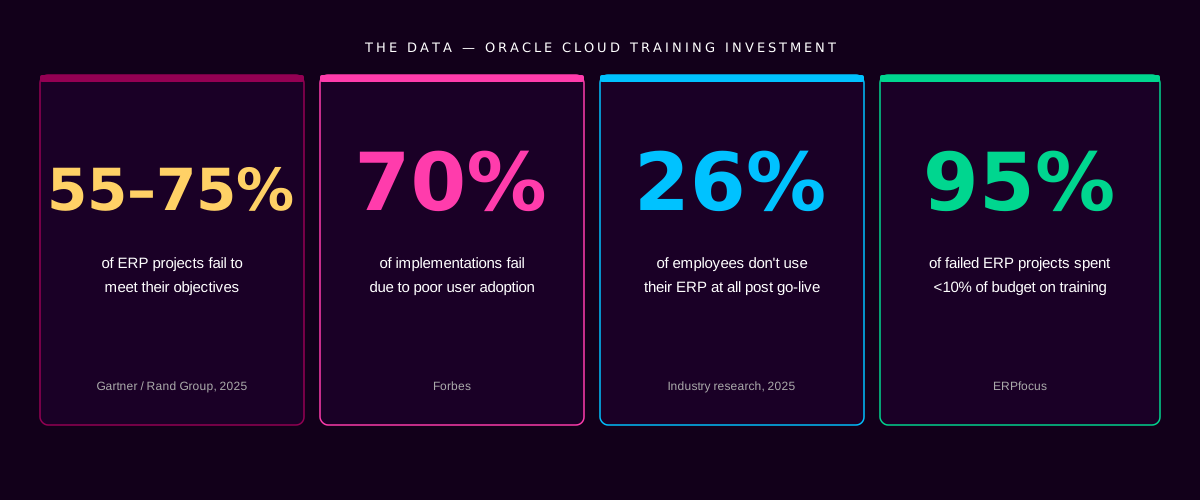
And 83% of senior executives say their biggest challenge in ERP projects is getting staff to actually use the software — not the configuration, not the integration. The people (ERP Software Blog).
This is not a coincidence. It is a pattern repeated across industries and across decades, and it is entirely preventable.
What I see on the ground
In our work with clients across manufacturing, financial services, public sector and professional services, the story is almost always the same.
The system integrator delivers the configuration. The licences are purchased. The project plan is built around technical milestones: data migration, integration testing, and UAT sign-off. Training is scheduled for the final two or three weeks before go-live. Change management, if it appears on the plan at all, is a communications document drafted by someone who joined the project late.
This is not incompetence. It is a structural problem that runs through almost every Oracle project I have seen:
- Technology workstreams are visible, measurable and contractual
- Training and change management are softer, harder to quantify in advance
- When timelines slip and budgets compress, training gets cut first
- SIs are rarely contractually responsible for end-user adoption outcomes
"The most important question in any Oracle ERP project — will the people who need to use this system actually be able to use it, confidently, from day one? — goes unanswered until it is too late."
This pattern is particularly acute in Oracle Fusion Cloud projects, where the pace of quarterly releases means the gap between what users were trained on and what is actually in the system today grows wider with every passing month. Most organisations we speak to have only a partial picture of what has changed in their Oracle Fusion environment since go-live, and virtually no plan to keep their people aligned with it.
What "afterthought training" actually costs
When training is bolted on at the end - a few classroom sessions the week before go-live, a set of user manuals nobody reads, a train-the-trainer model that assumes super users had time to become experts - the consequences are immediate and lasting.
Productivity collapses at the worst possible moment
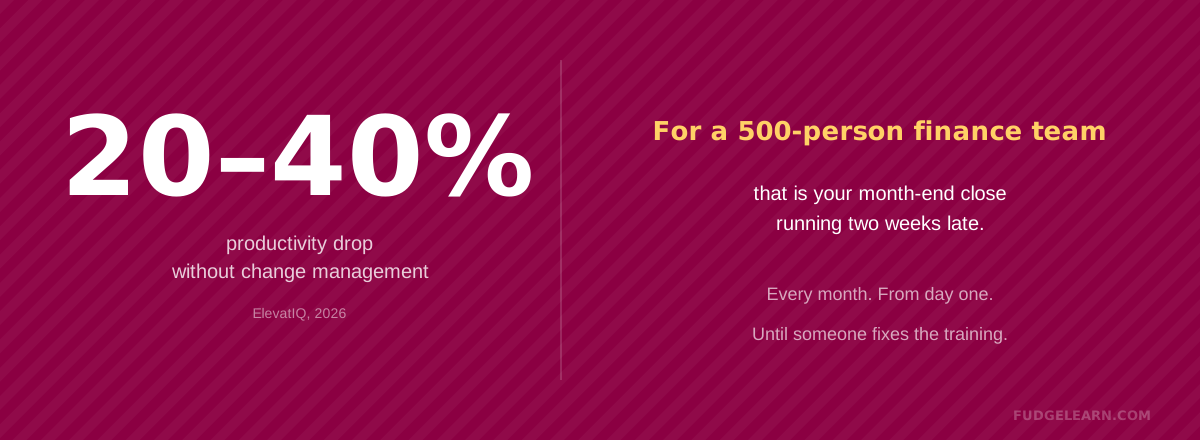
Research published in early 2026 by ElevatIQ found that without adequate change management support, productivity typically drops 20 to 40% during the initial adoption period. For a 500-person finance team, that is your close-of-month cycle running two weeks late. From week one, the procurement team raised purchase orders against the wrong cost centres.
And unlike a technical bug that gets patched, a productivity collapse caused by poor training does not fix itself. Without structured support, that loss extends for months rather than weeks.
Time haemorrhages silently across every team
Research published by the Harvard Business Review found that knowledge workers toggle between applications over 1,200 times per day, losing approximately four hours every week simply reorienting after switching — the equivalent of five full working weeks lost per year to avoidable friction. For a workforce not properly supported in their Oracle Cloud system, this loss compounds daily.
We see this in our own project work. When we implemented Oracle Guided Learning for Travis Perkins ahead of their Oracle Cloud go-live, one of the most consistent pieces of user feedback was how much time they had previously lost simply by not knowing where to go next in the system. In-application, step-by-step guidance - contextual support at the exact moment someone needs it - removes that friction entirely.
Data quality degrades from day one
When users are uncertain about the correct process, they make mistakes. Those mistakes compound across modules. Incorrect purchase orders affect supplier payment runs. Inaccurate financial entries distort management reporting. Corrupted HR data leads to payroll errors and compliance risks.
We have worked with organisations still recovering from data quality issues two years after go-live because the root cause — users who were not properly trained at the start — was never properly addressed.
The system becomes a liability, not an asset
The cruellest irony of poor adoption is this: the licence fees keep coming regardless. An Oracle Cloud subscription does not pause because your users are not using it effectively. What disappears is the return on that investment — the efficiency gains, the process improvements, the single source of truth that justified the business case in the first place.
As I have said many times to project sponsors, when companies invest millions in Oracle ERP, ensuring a return on that investment depends entirely on user adoption. And user adoption starts with good change management & training.
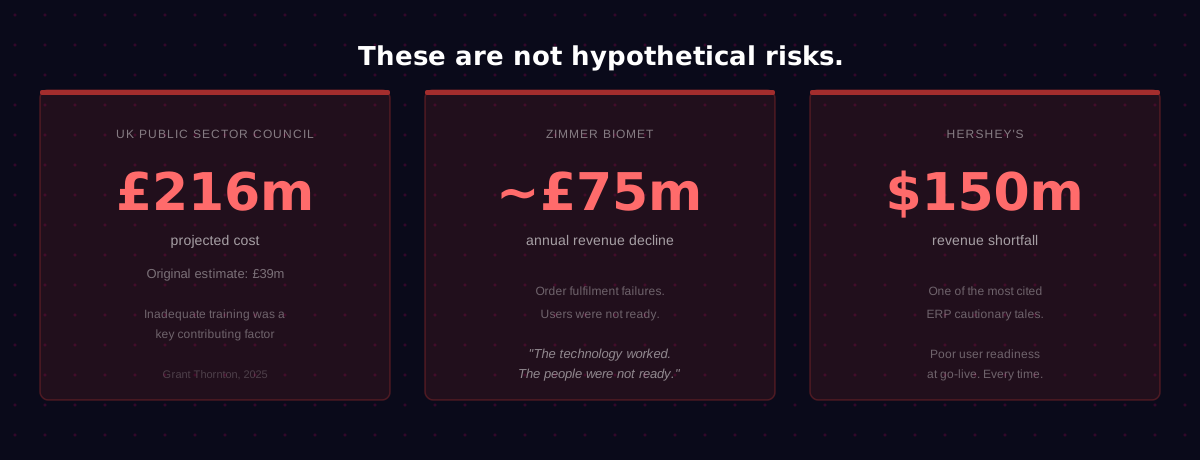
Real projects. Real consequences.
UK Public Sector Council
£216m projected cost — from a £39m estimate
A 2025 Grant Thornton audit found costs had already reached approximately £90 million, with projections reaching £216 million by 2026 — more than eleven times the original budget. Contributing factors included inadequate governance, a shortage of in-house expertise, and a workforce left without an effective system for over two years.
Zimmer Biomet
~£75m annual revenue decline
Hershey's
$150m revenue shortfall
One of the most cited ERP cautionary tales. Poor user readiness at go-live contributed to a $150 million revenue shortfall during the rollout period — demonstrating that implementation failure is rarely about the technology.
.svg)
What getting it right looks like — from our own experience
When we work with organisations the right way — with structured, role-based training built into the project plan from day one, not bolted on at the end — the difference is measurable.
With Travis Perkins, Fudgelearn delivered a blended model of classroom training, virtual sessions, custom documentation and Oracle Guided Learning ahead of their Oracle Cloud go-live. Presented at O5Live alongside Travis Perkins' Head of Finance Operations Systems and Finance Manager, the approach demonstrated how in-application guidance combined with structured pre-go-live training de-risked their entire user adoption programme.
Organisations that invest properly in training and change management — industry benchmarks suggest 10 to 15% of total implementation cost — report faster ROI realisation, lower post-go-live support costs, cleaner data from the start, and sustainable operational improvements. They do not spend months recovering. They start benefiting.
Programmes with strong adoption and change practices are up to five times more likely to meet objectives and stay on schedule than those without (Prosci).
See how we are helping our customers
Fudgelearn is an Oracle Fusion Cloud ERP capability and adoption partner, supporting organisations across implementation, go-live and continuous change. We combine Oracle Guided Learning, blended end-user training, and structured change management — designed to build adoption that lasts beyond go-live, not just to get users over the line.
We have delivered this to organisations including Ricoh, Travis Perkins, the FCDO, Brent Council, and many more. Read our customer case studies →
.svg)
Author: Tony Cook — Founder & CEO, Fudgelearn
Tony Cook has been working in the Oracle ecosystem since the mid-1990s. He founded Fudgelearn in 2017 after spending decades at Oracle conferences and noticing the same pattern: every session covered technology — almost none talked about the people who had to use it. Tony is an Oracle Cloud ERP Certified Pre-Sales Consultant, Certified Oracle Partner, and HM Government G-Cloud Supplier. He has led training and adoption programmes for Travis Perkins, Ricoh, FCDO, Brent Council and many others.
View LinkedIn profile →