

From Release Notes to Real Results: An OGL Developer’s AI Success Navigator Experiment
Lisa Evans | Oracle Guided Learning Developer
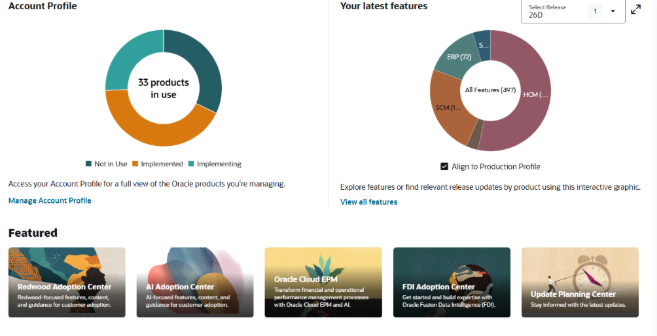
AI Success Navigator
As an Oracle Guided Learning (OGL) Developer, a large part of my role involves helping organisations adapt to change. Whether that is a quarterly Oracle Cloud release, a new business process, or a major transformation project, we are constantly looking for ways to make adoption easier and more effective.
Recently, I spent some time exploring Oracle AI Success Navigator and testing how it could support OGL activities across release readiness, guidance creation, regression testing, and change communications. What started as a simple evaluation quickly revealed some interesting possibilities.
Using AI to Prioritise OGL Content
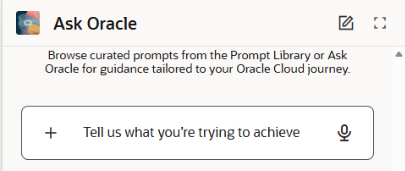
AI Assistant
One of the biggest challenges with quarterly Oracle releases is deciding where to focus effort first.
By using AI Success Navigator to analyse new features and changes, I was able to generate prioritised recommendations on which areas might require new OGL guidance, smart tips, or process support. Rather than manually reviewing every release note, the tool helped identify changes with the greatest potential business impact, user reach, and implementation complexity.
For OGL teams responsible for supporting multiple Oracle modules, this could become a valuable starting point for release planning.
Accelerating Guide and Smart Tip Creation
I also evaluated how effectively Ask Oracle could help generate ideas for OGL content.
Using 26C functionality as an example, Success Navigator provided suggested guide inventories, draft guide scripts, and smart tip recommendations. While the outputs still require SME validation and refinement, they provide a useful foundation that can significantly reduce the time spent creating first drafts.
The quality of the output improved noticeably when prompts were specific, structured, and focused on a particular feature or business process.
A Different Approach to Release Impact Analysis
Another area that caught my attention was impact assessment.
By uploading names of existing OGL guides and asking AI Success Navigator to analyse potential release impacts, the tool produced summary impact matrices highlighting areas that may require review. It also suggested recommended actions and testing priorities based on release changes.
Supporting Regression Testing and Change Readiness
Beyond content creation, I explored how the platform could assist with regression testing.
Success Navigator was able to summarise release changes, suggest testing scenarios, and prioritise areas likely to be impacted by mandatory UI changes across HCM, ERP, and SCM. This offers an interesting opportunity to align OGL validation activities with wider testing programmes and focus effort where the risk is highest.
Key Learning: Prompt Quality Matters
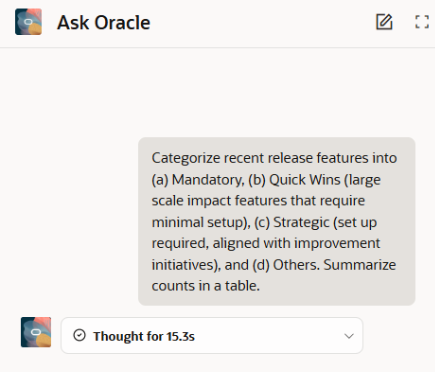
Example of Oracle pre-determined prompt 1
Perhaps the biggest takeaway from this exercise wasn't the technology itself but how it was used.
The most valuable outputs consistently came from well-structured prompts that clearly defined the objective, audience, business process, and expected outcome. The more context provided, the more actionable the response became.
For OGL professionals, this creates an opportunity to combine our understanding of Oracle processes, user adoption, and guidance design with AI-powered analysis.
Final Thoughts
Oracle AI Success Navigator is not a replacement for SMEs, OGL Developers, or testing teams. However, it has the potential to become a powerful assistant that helps identify priorities, accelerate content creation, support release planning, and improve change readiness.
For me, the most exciting aspect is not the automation itself. It is the ability to spend less time gathering information and more time focusing on what matters most: helping users successfully adopt change.
While Oracle AI Success Navigator helps organisations identify, assess, and prioritise change, Oracle Guided Learning can help turn those insights into practical guidance and support for end users. Together, they have the potential to bridge the gap between understanding change and enabling successful adoption.
Want to See It in Action?
This blog shares the findings from an initial hands-on exploration. To take a deeper dive, watch our on-demand virtual session, where we demonstrate practical examples and explore how Oracle AI Success Navigator and Oracle Guided Learning work together to support release readiness, guidance creation, testing preparation, and user adoption.
→ View On Demand