
Oracle AI World 2026 / Perspective
Oracle AI World 2026: AI pricing clarity, or have we opened the door to an open-ended cost model?
There was a lot to get excited about at Oracle AI World 2026. But amongst all the discussion about agents, automation and the future of enterprise AI, there was one subject I was particularly interested in:
What is all this actually going to cost?
It might not be the most exciting AI conversation, but for CIOs, CFOs and transformation leaders it could become one of the most important.
Oracle's direction is clear. Fusion is evolving beyond being simply a system of record towards what Oracle describes as a system of outcomes, where AI agents and agentic applications don't just surface information but increasingly coordinate and execute work against business objectives. Oracle's recently announced Fusion Companion and Fusion Agentic Home reinforce exactly that direction. Oracle
I think that's potentially a very significant change. But it also changes the commercial conversation.
First, the good news
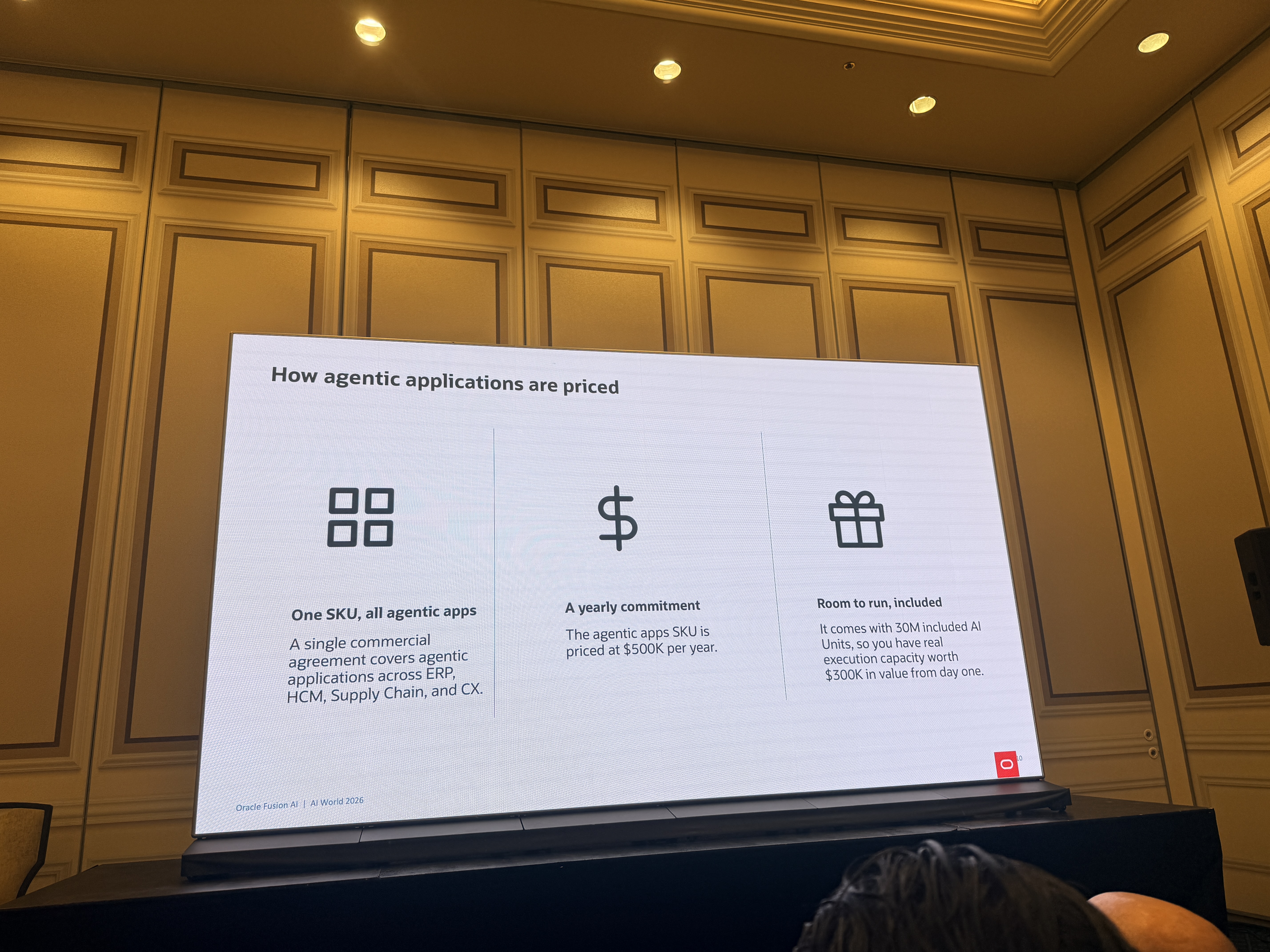
Oracle's approach to AI Units gives customers a common consumption mechanism for these AI capabilities rather than simply treating every agent as another traditional piece of software to license. The headline number is refreshingly easy to understand:
1 AI Unit = $0.01
AI Unit packs can currently be purchased in multiples of 100,000 units for $1,000 per pack. Oracle's estimator also refers to pooled allowances in certain circumstances, including a shared 20,000 AI Unit monthly allowance and 30 million pooled AI Units associated with the Agentic App SKU.
On the surface, that sounds straightforward. But this is where it starts to get interesting. Because knowing what an AI Unit costs isn't the same as knowing what AI will cost your organisation.
The real question is consumption
The amount an organisation ultimately spends will be driven by what its AI is actually doing.
Oracle's own estimator illustrates how usage can change according to things such as agent complexity, reasoning steps, tokens consumed, number of tools and tool calls, worker agents, workflow nodes, documents generated, user activity and the number of sessions taking place.
So consider the difference between:
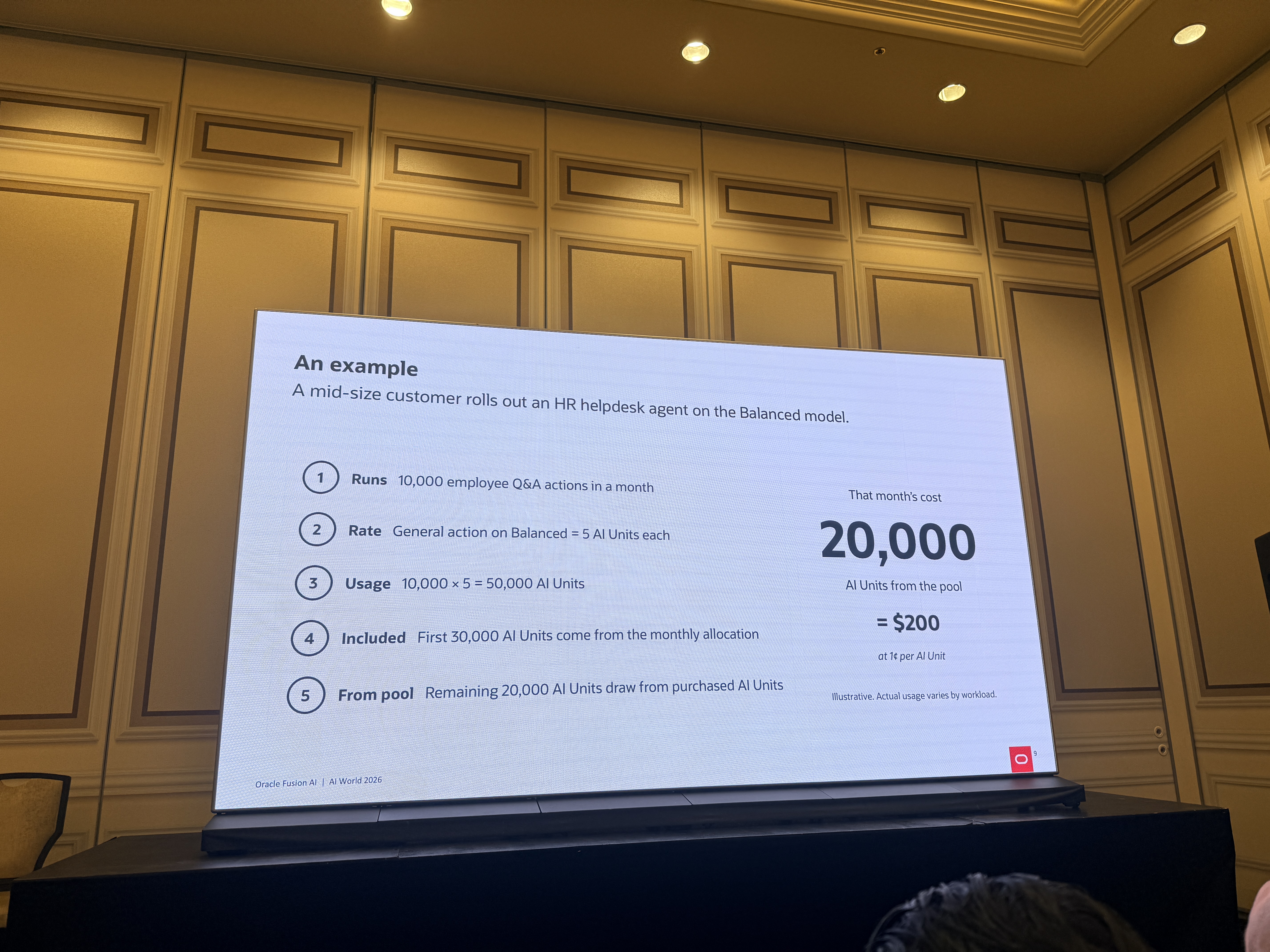
- an employee asking an agent a straightforward HR question;
- an agent summarising information from multiple sources;
- several agents collaborating on a workflow;
- an agent generating a document;
- or an agentic application carrying out increasingly sophisticated work on behalf of the user.
They're all ‘using AI’, but commercially they aren't necessarily the same thing. Then multiply that by hundreds or thousands of employees. That's where predicting the bill gets considerably harder.
A simple example shows the challenge
Oracle's own AI Units estimator suite gives a useful illustration. Its current example for a single agent assumes 200 daily active users, with the resulting workload consuming 195,300 AI Units per month, equating to an estimated $1,953 per month.
Importantly, Oracle describes the calculator as a lower-end planning baseline, explicitly says actual usage and cost may vary, and states that the estimate is not a binding offer or guarantee of final cost.
That isn't a criticism. In fact, I think providing an estimator is exactly the right thing to do. But it demonstrates the bigger issue perfectly.
An AI business case is only as good as its assumptions about consumption.
And most organisations simply don't have enough real-world enterprise agent usage data yet to know whether those assumptions are right.
We could be moving from licence management to AI consumption management
This, for me, is the bigger conversation coming out of AI World. For years organisations have worried about software licensing. How many users? What licences do they need? Who has access? Are licences actually being used?
Agentic AI changes the equation. The question increasingly becomes:
How much work is the AI doing on our behalf?
That's potentially much harder to forecast. Imagine an organisation successfully drives AI adoption. Employees embrace agents. New use cases appear. Agents begin collaborating with other agents. Processes that initially required a handful of interactions become increasingly autonomous.
From an adoption perspective, that's success. From a Finance perspective, it could also mean increasing consumption.
Which creates an interesting tension: could the successful adoption of AI ultimately drive an AI bill that wasn't fully anticipated when the original business case was approved? I think that's a very real question.
This is why AI governance can't just be about security
A lot of the AI governance conversation quite rightly focuses on data, security, permissions, risk and responsible AI. Oracle itself emphasises that Fusion Companion and Agentic Home operate within established enterprise permissions, policies, approval controls and accountability structures.
But I think we need another dimension: commercial governance.
- Who owns the AI consumption budget?
- Who monitors actual consumption against the original business case?
- Who decides whether a new agent represents sufficient value for the additional consumption?
- And when AI spreads across Finance, HR, Procurement, Supply Chain and other functions, who owns the overall enterprise AI economics?
Those aren't technology questions. They're operating-model questions.
Start small. Measure properly. Scale what creates value.
None of this changes my view of the opportunity. I'm genuinely excited by Oracle's agentic direction.
Oracle says Fusion Agentic Home will allow employees to define business objectives, delegate work to AI agents and agentic applications, and track that work through to completion. Fusion Companion is intended to coordinate the transactions, workflows, approvals and agents required to achieve those outcomes.
That's a potentially fundamental change to how people interact with enterprise applications. But technical capability and commercial predictability need to develop together.
My advice to customers would therefore be quite simple: don't try to predict enterprise-wide AI economics from a spreadsheet alone.
- Start with a small number of genuine, high-value use cases.
- Establish a baseline.
- Measure actual consumption and the business outcome alongside it.
- Understand the cost per successful outcome, not simply the cost per AI Unit.
- Then scale.
Because the really interesting metric isn't whether an AI Unit costs one cent. It's whether the business value created by consuming those units comfortably exceeds their cost.
The next FinOps conversation?
Perhaps that's ultimately where we're heading. We've already developed disciplines such as FinOps to bring financial accountability to variable cloud consumption. I suspect organisations are going to need a similar discipline for enterprise AI.
Not simply ‘Can we build an agent to do this?’ But:
- Should we?
- What's it costing?
- What value is it creating?
- And should we scale it?
AI Units give Oracle customers a mechanism for consuming AI. The next challenge is giving organisations enough real-world evidence to confidently predict, govern and optimise that consumption. And that, for me, could become just as important as the AI technology itself.
I'd be interested in the view of Oracle customers, partners, CIOs and Finance leaders. Are you comfortable building business cases around a consumption-based AI model? Or do we need much more real-world benchmarking before organisations can confidently forecast the economics of enterprise agentic AI?
And perhaps the bigger question: who should own the AI consumption budget when agents are embedded across the enterprise?
Sources
Oracle Introduces New AI-Powered Ways to Execute Work Across Oracle Fusion Applications, 26 October 2026.